
The problem
Discovery happens. Then scope gets lost.
Every product starts with good conversations. But the gap between what people say and what gets built is where projects go sideways.
Requirements drift
Conversations produce insights. Then scope gets manually translated into tickets — losing context and specificity at every handoff.
Wrong order, wrong things
Without true dependency ordering, teams build features that block each other — discovering the hard way that step 3 needed step 7 first.
AI agents fly blind
Your coding agents are only as good as their instructions. Point them at vague tickets and they produce vague code.
How it works
The loop that closes itself.
Five steps. One continuous cycle. Every iteration sharpens scope and accelerates delivery.
Intent ingestion
Ideas come from everywhere. Nothing gets lost.
Discovery doesn’t live in one app. Connect Google Drive, Notion, or Microsoft 365, forward emails, or drop in meeting transcripts — it all lands in your project’s Intent Inbox, where ScopeLoop turns raw intent into draft requirements ready for your review.
Structured scope
From discovery to structured, testable requirements.
Capture stakeholder interviews and raw notes, then turn them into clean requirements with clear acceptance criteria. No more ambiguity, no more drift.
Build plans
Build order equals dependency order.
Requirements are organized in true build order — milestone sequence follows dependency sequence. Teams build things in the order that actually makes sense, not the order someone guessed.
Living specs
Living specs that move through a real workflow.
Each requirement carries a full specification, version history, and acceptance criteria — and moves through a real workflow from draft to complete.
Smart prioritization
Always know what’s next.
ScopeLoop recommends the best next piece of work to pick up — based on dependencies, impact, and what’s unblocked. Nobody stares at a backlog wondering where to start.
Delivery pipelines
Approve the spec. ScopeLoop drives the build.
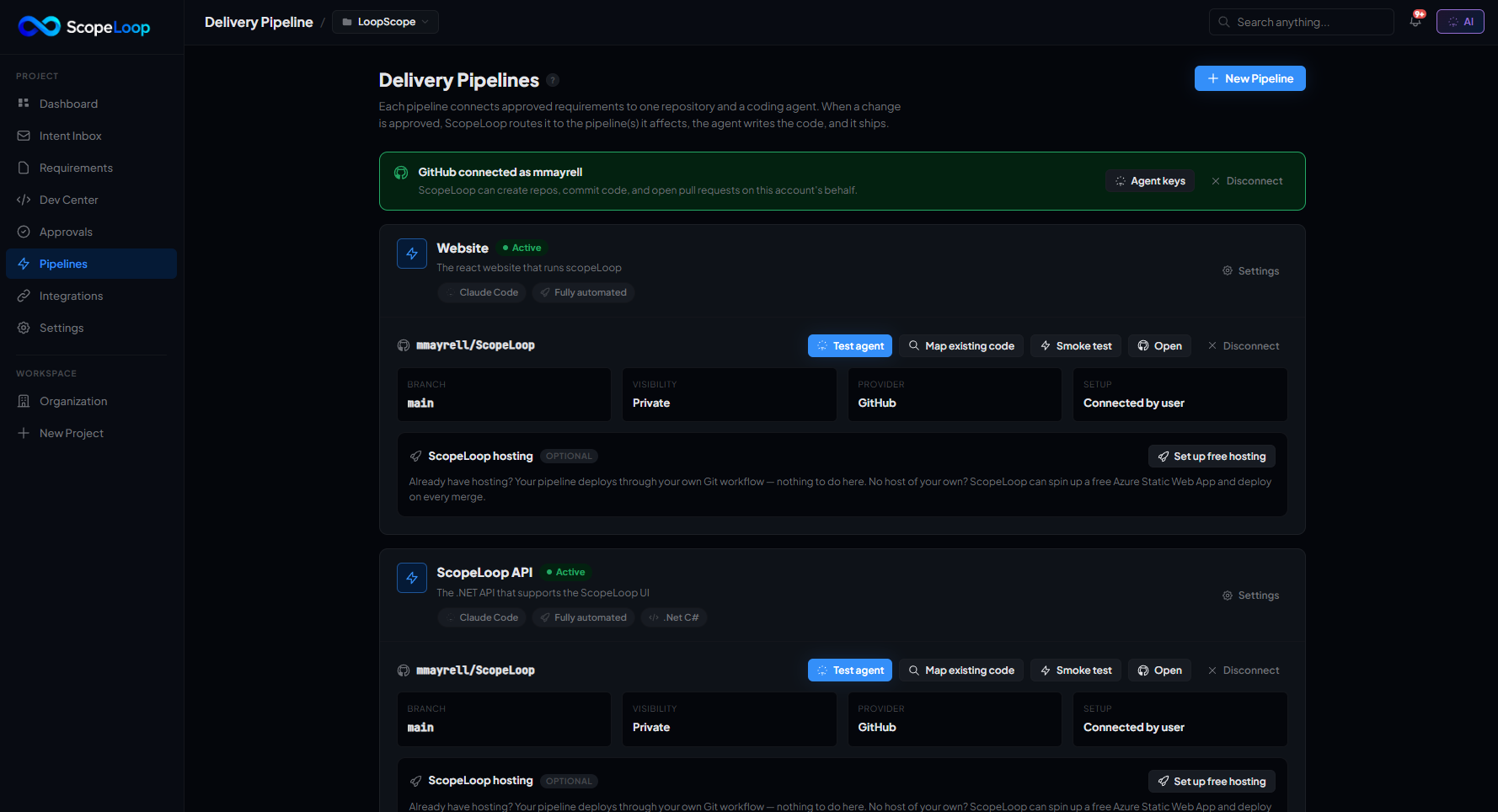
Connect a repository and a coding agent — Claude Code or Codex — to your project. When a requirement is approved, ScopeLoop hands it to the right pipeline as a work order: the agent writes the code and opens a pull request, and your change ships through your normal Git review. AI does the work; you stay in control of what ships.
The differentiator · Drift Watch
When code drifts from the spec, you’ll know.
Every other SDD tool hands you a spec and watches it rot. ScopeLoop is built the other way: every merged commit is AI-reviewed against your specs. When code diverges, ScopeLoop raises the spec change to reconcile it — or drafts a new requirement when the code did something no spec described. Your source of truth stays true, in both directions.
Build-ready scope
No more garbage in, garbage out.
AI builds exactly what you wrote — including the gaps. ScopeLoop rates every requirement build-ready before an agent ever touches it: it flags ambiguity and missing criteria, and one click enriches the spec — grounded in your project goal and neighboring requirements. A build gate holds vague specs back until they’re ready.
Built for builders
Who ScopeLoop is for.
Product Leaders
Turn stakeholder conversations into structured scope your team can actually execute against. Stop losing requirements in translation.
Engineering Managers
Get a dependency-ordered build plan instead of a flat backlog. Your team always knows what to build next — and so do your AI agents.
Consultants & Dev Shops
Scope client projects with precision. Deliver structured requirements and build plans that earn trust and reduce rework.
Founders & Solo Builders
Ship real software without a big team. Describe what you want, approve the specs, and let connected agents handle the building — with you in control.
Get started
Start building with ScopeLoop.
Create your project, connect your tools, and keep your specs and code in sync — sign up and you’ll set up your account in a couple of clicks.
Sign up